Data Encryption: Understanding the Fundamentals to Protect Your Business
Data encryption protects your business from theft and ransomware: key principles, types and best practices for small and medium-sized businesses.

Thierry Leblond
CEO & Co-founder
8 mins
- Cybersecurity
Every business handles sensitive data: contracts, customer data, banking information, trade secrets. Data encryption is one of the essential links in the cybersecurity of very small businesses and SMEs. By allowing only the holder of the access keys to read, use or modify the data, it provides particularly effective protection against hacking, theft and tampering.
This guide, written by Parsec, a data security specialist listed as a France Num Activator, explains what encryption is, how it works and why it is now indispensable to any cybersecurity strategy, whatever the size of your company.
Why every small business and SME must protect its data
Risks that affect businesses of every size
Cybersecurity is not a concern exclusive to large companies. According to the 2025 national barometer of cyber maturity among very small businesses and SMEs published by Cybermalveillance.gouv.fr, 80% of them admit they are not sufficiently prepared for a cyberattack, and nearly 6 in 10 admit they do not know how to assess the consequences of a security incident.
Yet the stakes are vital. An analysis by Bessé / G.P. Goldstein of 48 cyber incidents affecting unlisted French companies between 2017 and 2021 shows that the risk of the company failing increases by about 50% in the 6 months following the announcement of the incident, because it cannot absorb the costs of recovery, the loss of business and any regulatory penalties.
Sensitive data in every sector
All small businesses and SMEs handle sensitive personal data:
- customer files;
- employee data;
- banking information;
- contracts;
- etc.
Many companies also hold confidential documents covered by trade secrets or intellectual property. Some sectors are particularly exposed:
- Car garages keep copies of vehicle registration certificates, documents with administrative value, often stored in a simple shared folder or a mailbox.
- Law firms and strategy consultants handle information covered by professional secrecy: ongoing disputes, financial structures, disposal transactions.
- Real estate professionals receive and forward payslips, bank statements and loan offers, all of which are personal data under the GDPR.
- Engineering firms and industrial subcontractors hold plans, pending patents and trade secrets that make up their competitive advantage.
In all these cases, a data leak can lead to financial penalties, a loss of customer trust and legal liability for the company.
What is data encryption?
Data encryption plays a crucial role in cybersecurity: it consists of transforming readable data into a secret code that can only be decrypted with a specific digital key. A mathematical algorithm (the encryption software) creates an encryption scheme that, in theory, can only be broken with exceptional computing power.
Imagine slipping a confidential document into a locked box before sending it by post. Only the person who holds the key to that box can open it and read the document; no one else, neither the postman nor the postal operator, can access the content. Digital encryption works on exactly this principle: without the matching key, it is impossible to recover the original content, even with a very powerful computer.
The key is essential to access encrypted data. It can only be read or modified after being decrypted.
In the event of theft or intrusion, encryption provides a robust barrier by making the data unreadable without the appropriate key. The information remains secure whether it is stored on computers, in transit, or during processing.
From data encryption to cryptography
Cryptography refers to the set of mathematical techniques used to protect data. It offers robust protection against data leaks, whether accidental or caused by a malicious act. In particular, it ensures:
- Data confidentiality: encryption maintains data confidentiality by making it unreadable to anyone unauthorized. Even if someone manages to intercept the data, it is unusable without the appropriate decryption key.
- Data integrity: hackers do not just steal information, they can also alter data for fraudulent purposes. Through hash functions or message authentication codes, cryptography helps guarantee data integrity by detecting any unauthorized alteration or modification: any change made to encrypted data is detected during the decryption process, which reveals a breach of data integrity.
- Data authentication: cryptography is also used to verify the authenticity of data and of the sender. Electronic certificates and digital signatures make it possible to ensure that data comes from the expected source and has not been altered during transmission.
To learn more, read the CNIL article (in French): Comprendre les grands principes de la cryptologie et du chiffrement (Understanding the main principles of cryptology and encryption).
There are 2 types of encryption, depending on how the key is managed.
Symmetric encryption: one key for everyone
In symmetric encryption, the same key is used both to encrypt and to decrypt the document. It is the simplest system: you lock the box with a key, and your recipient opens it with the same key. Compression software (a password-protected ZIP archive, for example) works on this principle.
Simple to implement, it proves more limited for exchanging information. How can you pass the key (the password) to the recipient without a third party being able to intercept it? At the very least, different channels should be used: if the encrypted document is sent by email, the key can be sent by SMS. This is the fundamental problem of symmetric encryption whenever data must be shared with other people.
Symmetric encryption is also used for disk encryption, which encrypts the entire contents of a computer or a USB key; its strengths and limitations are detailed below.
Asymmetric encryption: one key to lock, another to open
Asymmetric encryption solves this problem with an ingenious idea: each user has two keys that are mathematically linked but distinct.
- The sender’s public key can be freely shared with everyone. It is used to encrypt a message for its owner.
- The private key is known only to its owner. Only it allows the recipient to decrypt the messages that others have sent them using their public key.
Imagine an open padlock (the public key) that you distribute freely: anyone can take it, slip a document inside and close it. But you are the only one who holds the key that opens this padlock (the private key). You can hand out as many open padlocks as you like; no one will be able to open them in your place.
This is the principle behind the end-to-end encryption technologies used today to secure communications and file sharing between several people.
Why encrypt your company’s data?
A bulwark against ransomware attacks
Ransomware is a real threat to small businesses and SMEs. While it is not the most frequent threat (it accounted for 8.1% of assistance requests to Cybermalveillance.gouv.fr in 2025), it is one of the most formidable for an organization.
Malicious software enters the information system, often via a booby-trapped email attachment, and encrypts all of the company’s files, which then become inaccessible. The attackers demand a ransom to give the data back. If a company’s data is centralized on a non-partitioned server, a single attack can compromise everything at once.
Protection against interception attacks
Companies increasingly use services hosted outside their premises, such as the cloud or SaaS services, and fewer and fewer internal servers. As a result, their data constantly travels over networks. If the data is not encrypted, it is exposed to the risk of interception.
When data is encrypted, it is much harder for an attacker to intercept and understand: even if they manage to obtain the encrypted data, they cannot read it without the appropriate encryption key.
Data sovereignty and regulatory compliance
The major digital service providers (cloud, online storage, office suites) are mostly American. Their data, even when hosted in Europe, may be subject to US legislation that allows US authorities to access it without necessarily informing the European companies concerned. For a company handling data covered by professional secrecy or falling under the European General Data Protection Regulation (GDPR), this situation raises legitimate questions of compliance and legal liability.
Data protection regulations encourage or require data encryption, depending on its level of sensitivity. Encryption helps meet the personal data protection requirements set by the GDPR.
Which encryption approach should you adopt?
Understanding the three states of data
In its practical guide on encryption in the cloud, the CNIL distinguishes 3 states in which data can exist, and points out that the protection measures to apply differ depending on the state:
- Data at rest is stored persistently (on a hard drive or an SSD) without being actively used or transmitted.
- Data in transit is data moving across a network: a sent email, a file transferred to online cloud storage, a message exchanged on an instant messaging service.
- Data in use is data being viewed, updated or analyzed by a user, an application or a service.
In each of its states, data can benefit from encryption to improve the company’s level of security.
Encryption applied to each state of data: a useful but limited approach
Disk encryption (data at rest), which encrypts the entire contents of a computer or a USB key, ensures that if the hardware is stolen, no one can access the data without the password. This is a useful protection that should always be enabled.
But as soon as the computer is turned on and connected, the data exchanged with the outside (data in transit) is decrypted and becomes readable again by the user, but also by any network or online service these files are then sent to. Disk encryption therefore does not protect data once it leaves the device. To encrypt data in transit, other encryption tools are needed, such as a VPN solution that encrypts the data flows exchanged to make them unreadable.
Data sent to a remote server, cloud storage or a SaaS solution, such as a remote ERP or CRM, and processed by these solutions (data in use), is also exposed if it is stored in clear text (unencrypted), particularly in the event of a data leak.
By not encrypting data in all of its states (at rest, in transit and in use), you expose it to specific risks. End-to-end encryption addresses this issue by ensuring continuous encryption throughout the use of the data.
End-to-end encryption: reinforced protection
With end-to-end encryption, data is encrypted (and signed) before it even leaves the sender’s device, and is only decrypted (and verified) on arrival, on the authorized recipient’s device. In between, during transport, on the provider’s servers and in data centers, the data remains encrypted and unreadable to anyone who does not hold the key.
This is the fundamental difference with a conventional cloud storage service, which may encrypt data in transit and at rest, but keeps the decryption keys, and can therefore, itself or through a third party compelling it, access the data.
Some messaging applications, SMS and other communication services rely on end-to-end encryption to protect messages against unauthorized access.
This approach makes it possible to implement a Zero Trust architecture, which assumes that no person, device or application should be trusted by default, whether inside or outside the company network.
This type of architecture should be favored to secure data as much as possible, particularly in the context of information exchange and collaboration. It prevents the company server that centralizes its data (whether hosted on its premises or with a provider) from becoming a single point of vulnerability.
AI-generated image
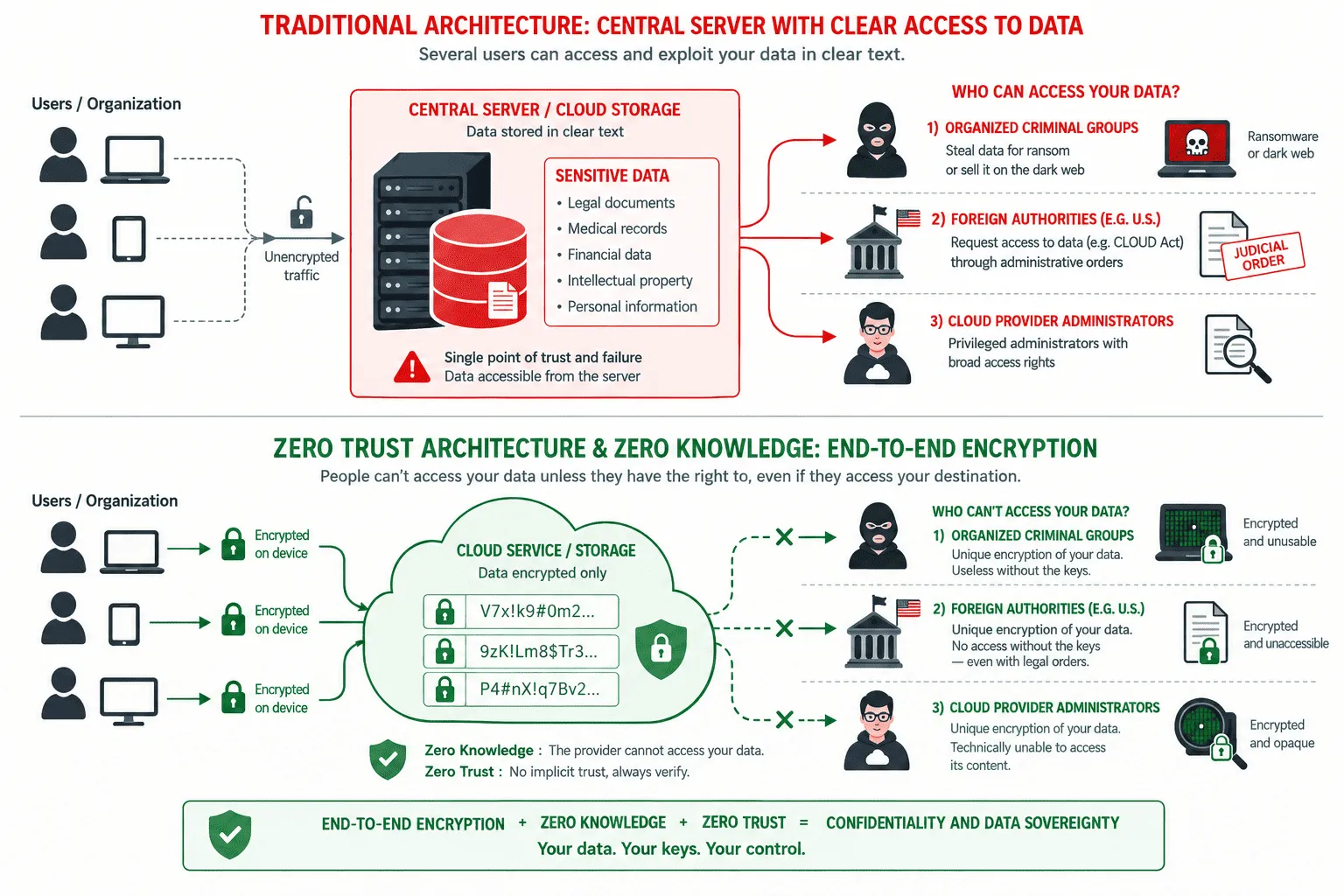
In the traditional architecture, at the top of the diagram, the central server stores data in clear text or with keys that it controls. Three actors can access it: organized criminal groups (ransomware operators or resellers on the dark web), foreign authorities (via the Cloud Act), and the cloud provider’s administrators.
In the Zero Trust architecture, at the bottom of the diagram, data is encrypted on the user’s device before being sent: the server only stores unreadable encrypted data. These same three actors only see unusable data, without the keys that only the user holds.
The expert’s advice
For a budget that is often equivalent to that of conventional solutions, it is possible to move your data to a solution that includes end-to-end encryption and thus benefits from the highest level of protection.
One point to anticipate: in an architecture where the provider never holds the decryption keys, a password lost by an employee can make their files permanently inaccessible, even to the provider itself. There is indeed no “back door” reset procedure as on a conventional service. An internal procedure for backing up access, such as setting up a shared password vault, is therefore recommended. These tools include mechanisms for backing up personal keys, associated reminders and cloning of one’s device.
Another nuance to be aware of: end-to-end encryption protects the content of files and messages, but not always the associated metadata (who communicates with whom, at what time, the name or size of a file). Depending on the solution, this information may remain visible to the provider. It is advisable to ask the provider explicitly what is not covered by encryption before concluding that the offer is completely watertight.
Finally, to make the choice of a provider more objective, the qualification or certification issued by the French National Cybersecurity Agency (ANSSI), a France Num partner, is a reliable benchmark: it attests to an independent evaluation of the product’s robustness and, for qualification, to the provider’s compliance with French regulatory requirements.
Start securing your sensitive data today
Enjoy a 15-day free trial — You can cancel anytime.